The New UK–Switzerland Free Trade Agreement: What Does It Mean for Swiss Businesses?

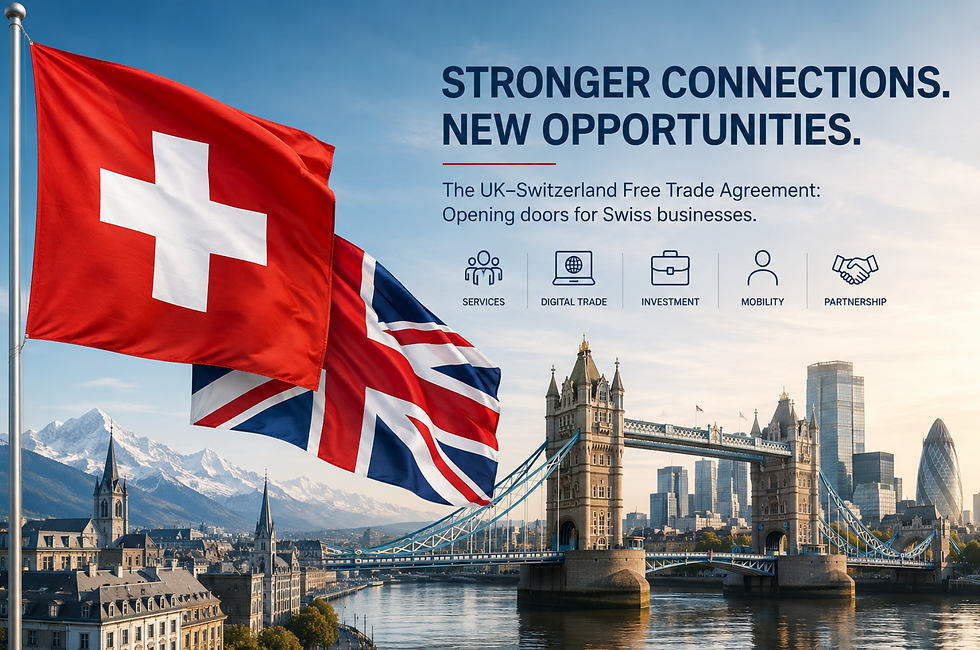
In July 2026, Switzerland and the United Kingdom concluded negotiations on a new enhanced Free Trade Agreement.
At first glance, another trade agreement might not sound particularly exciting. But this one is worth paying attention to — especially for Swiss companies selling services, technology or expertise.
The reason is simple: the old Swiss–UK trade relationship was largely designed around goods. The new agreement goes much further.
It covers services, digital trade, investment and business mobility and is intended to make it easier for Swiss and British companies to do business across the border.
The agreement is not yet in force. It still needs to be signed and go through the respective approval processes. But once implemented, it could create some interesting new opportunities for Swiss companies.
From trading goods to trading services
Swiss companies can already export most goods to the UK tariff-free under the existing arrangements. Around 99% of current goods trade is already eligible for tariff-free access.
The bigger change therefore isn’t about watches, chocolate or machinery suddenly becoming cheaper to export.
It’s about services.
The new agreement covers areas such as consulting, engineering, IT, software, finance, architecture and other professional and technical services.
For Swiss companies, that makes the UK potentially more attractive as a market that can be served directly from Switzerland.
A small software company in Zurich, for example, may not necessarily need to establish a large British operation simply to acquire British customers. An engineering consultancy in Basel may be able to undertake projects for British clients while keeping much of its team in Switzerland.
The agreement is designed to make this kind of cross-border business easier and more predictable.
Moving people becomes easier
Services often cannot be delivered entirely over the internet.
A Swiss manufacturer selling equipment to a British factory may need to send engineers to install it. A technology company may need specialists on site to configure a system. A consultancy may need people working temporarily with a British customer.
The new agreement establishes more permanent rules around this type of business mobility.
In particular, the agreement provides visa-free access for highly skilled Swiss workers delivering services in certain sectors in the UK for periods of up to three months.
It also provides greater certainty around intra-company transfers and other forms of business travel.
That could be particularly valuable for Swiss companies in engineering, industrial automation, IT, AI, consulting and specialist manufacturing. (GOV.UK)
A particularly interesting agreement for digital companies
Perhaps the most forward-looking part of the agreement concerns digital trade.
Switzerland and the UK have agreed their most comprehensive digital trade chapter to date.
It protects cross-border data flows and seeks to prevent unnecessary requirements for companies to store their data locally. It also establishes rules around electronic contracts, electronic signatures, digital payments, electronic invoicing and paperless trade.
There are even specific protections against governments requiring companies to disclose software source code or cryptographic information simply as a condition for doing business.
For a Swiss SaaS, AI, fintech, cybersecurity, IoT or data company, these provisions could be particularly important.
A Swiss technology company should increasingly be able to think of Britain as a market that can be served digitally from Switzerland rather than necessarily as a completely separate operation requiring duplicated infrastructure. (GOV.UK)
Easier investment in the UK
The agreement also strengthens the environment for investment between the two countries.
This is not a small economic relationship. Swiss companies already had approximately £44 billion invested in the UK at the end of 2024, and around 150,000 people in the UK were employed by Swiss companies.
The agreement is designed to provide greater long-term certainty for companies investing and operating across the two markets. (GOV.UK)
For a growing Swiss SME, an increasingly attractive model could therefore be:
Switzerland: headquarters, R&D, engineering and intellectual property
United Kingdom: sales, customer service and access to the British market
Swiss specialists could then move between the two operations when required.
Manufacturing benefits too — but differently
For traditional exporters, the changes are less dramatic because most goods trade is already tariff-free.
Nevertheless, the agreement aims to make customs procedures faster and more digital.
Paperless trade, electronic customs documentation and simplified origin procedures should gradually reduce some of the administrative burden associated with moving goods between Switzerland and Britain.
The agreement also maintains important rules allowing components originating in the EU and other participating European countries to count towards the origin of certain products.
That’s important for Swiss manufacturers whose products often contain components from Germany, France, Italy and elsewhere in Europe.
A bigger opportunity than tariffs
The most interesting way to look at this agreement is therefore not:
“Will Swiss products become cheaper in Britain?”
For many products, tariffs were already largely eliminated.
The better question is:
“Will it become easier for a Swiss company to treat the UK as an additional market?”
And in many sectors, the answer appears to be yes.
The biggest potential beneficiaries are likely to include:
Software, SaaS and AI companies
Engineering and industrial technology companies
Consultants and professional services firms
Fintech and financial services companies
Life sciences and pharmaceutical companies
Cybersecurity and data businesses
Swiss SMEs looking to establish a UK operation
The agreement also complements other recent Swiss–UK agreements covering financial services and recognition of professional qualifications.
Taken together, they are creating something increasingly resembling a Swiss–UK business corridor.
Two countries with quite a lot in common
There is also a broader strategic reason why the agreement makes sense.
Switzerland and the UK are unusual European economies.
Both are outside the European Union but remain deeply connected to the European economy. Both have large financial and professional services sectors. Both are highly international. Both depend heavily on innovation, technology and international trade.
The new agreement reflects that reality.
Instead of concentrating primarily on tariffs and physical products, it focuses much more heavily on how modern companies actually operate: people, services, investment, intellectual property and data.
For Swiss businesses, Britain therefore deserves another look.
A Swiss SME that dismissed the UK after Brexit because entering the market appeared too complicated may find that the calculation is beginning to change.
And for Swiss technology and service companies in particular, the new agreement could make the UK one of the more interesting nearby markets for international expansion.
The UK–Switzerland Enhanced Free Trade Agreement is not yet in force. Negotiations concluded on 13 July 2026, and both governments are now working towards signature and implementation.


https://www.gojiliwin.org/ leads me to assess how the organization of information affects the overall browsing experience. A well-arranged page should separate its main sections clearly while keeping related content easy to compare. Casino games, fishing games, and bingo offer examples for reviewing whether category headings, images, and descriptions follow a logical hierarchy. I would pay attention to the amount of information shown at once and whether users can scan the page without being distracted by competing visual elements. Repeated design patterns can support recognition, but every section should still communicate its own purpose. The objective is to create a structure that feels coherent and understandable rather than crowded or unnecessarily complicated.
JILIWIN leads me to evaluate the role of instructions and game information in the browsing process. Different formats may require different explanations, particularly when their rules and controls are not immediately obvious. I would review card games, casino games, and slot games to consider whether descriptions, help sections, and relevant information are presented clearly. A user-focused design should make essential explanations accessible before someone begins interacting with a game. I would also look for consistent terminology and straightforward navigation between the game screen and its instructions. These features can reduce uncertainty and support better understanding. My assessment remains centered on clarity and usability rather than assuming that attractive graphics alone create a satisfactory experience.
https://www.88jl88.net/ makes me pay attention to the way different content styles appear as I move through the main categories. I often begin with a quick look at the lobby before selecting a section. Poker introduces a recognizable card-table setting, while Lottery shifts my focus toward numbers and results. Later, Fishing Games brings underwater imagery and moving targets onto the screen. The navigation menu gives me a familiar reference point while exploring these areas. As I continue browsing, their individual themes and positions gradually become easier to remember, helping me develop a natural sense of direction during later visits.
https://sp8beta.net/ qua nhiều lần quay lại khiến mình bắt đầu chú ý đến những yếu tố ảnh hưởng đến thói quen sử dụng lâu dài. Mình thường tìm hiểu Casino trước rồi chuyển sang Game bài để quan sát cách hai khu vực được giới thiệu. Khi sử dụng trên điện thoại, mình có xu hướng tập trung vào từng phần thông tin và chú ý đến cách nội dung được thu gọn theo màn hình. Những phiên trên máy tính lại giúp mình quan sát nhiều khu vực cùng lúc. Qua đó, mình dần nhận biết được cách lựa chọn thiết bị có thể làm thay đổi nhịp tìm kiếm và trải nghiệm của bản thân.
F168 giúp tôi quan sát cách các nhóm nội dung được phân chia theo đặc điểm sử dụng. Tôi thường xem xét tiêu đề, hình ảnh minh họa và vị trí hiển thị trước khi mở từng khu vực. Khi kiểm tra các danh mục ở giữa quá trình trải nghiệm, tôi lựa chọn Bắn cá, Game bài và Casino để đánh giá khả năng phân biệt giữa những nhóm giải trí. Sau đó, tôi chuyển sang khu vực hỗ trợ và tài khoản nhằm xem các chức năng này có được trình bày riêng biệt, dễ nhận diện hay không. Tôi cũng thử quay lại trang chính để kiểm tra tính nhất quán của bố cục. Với tôi, cách phân…